

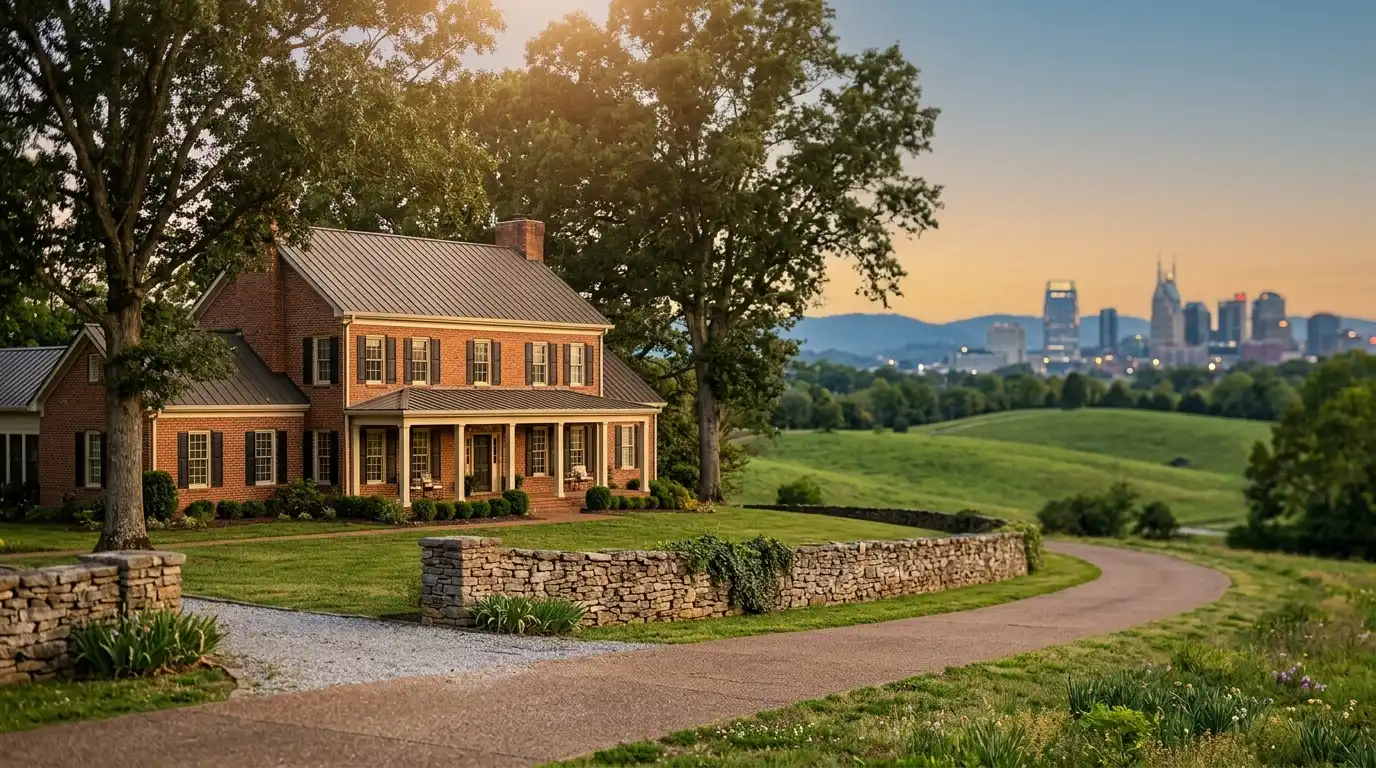
Moving to Nashville from New York: The Complete Relocation Guide (2026)
The New York to Nashville move has gone from a trickle to a steady stream, and for good reason. Buyers who have spent years navigating high taxes, long winters, and dense, expensive housing are discovering that Middle Tennessee offers a different equation entirely: no state income tax, property taxes a fraction of what they paid up north, and the kind of land and square footage that simply is not available at the same price point in Westchester, on Long Island, or in the five boroughs.
We are The Hetherington Team, a Franklin-based luxury real estate team with more than 20 years of experience, and relocating buyers are the heart of what we do. This guide walks through the real numbers behind the move, the lifestyle trade-offs, and where New York transplants are actually landing in Williamson County. Where we cite figures, we attribute the source, because relocation decisions deserve real data rather than sales talk.
What This Guide Covers
- The tax difference: no Tennessee income tax vs New York state and city taxes
- Home price and cost-of-living comparison across both metros
- How much more home and land your money buys
- Property taxes, climate, and culture
- The best Williamson County areas for New York transplants
- Logistics and timeline for the actual move
The Tax Story: Why So Many New Yorkers Are Heading South
For most relocating buyers, taxes are the headline. Tennessee does not levy a state individual income tax on wages or salaries for the 2025 or 2026 tax years, according to the Tax Foundation. New York, by contrast, runs a graduated state income tax with a top marginal rate of 10.9 percent, and New York City residents pay an additional local income tax of up to roughly 3.876 percent on top of that, per the Tax Foundation and NerdWallet.
The trade-off worth understanding is sales tax. Tennessee has a 7 percent state sales tax, and combined state-and-local rates can reach up to 9.75 percent, among the highest in the country, according to the Tax Foundation. For most households, though, the absence of income tax outweighs the higher sales tax, because income is taxed on everything you earn while sales tax only applies to what you spend.
A Note on Taxes
This is general information, not tax advice. Your actual savings depend on income, deductions, the timing of your New York exit, and residency rules that New York takes seriously. Before you move, sit down with a licensed CPA who handles multi-state relocations. We are happy to refer you to advisors who work with our relocating clients.
New York vs Tennessee: The Side-by-Side
Here is the comparison most relocating buyers ask us for, pulling together 2025 to 2026 figures from public sources. Treat home prices as moving targets and confirm current numbers when you are ready, but the relationships between the markets are consistent.
| Factor | New York (NYC / Westchester / Long Island) | Tennessee (Nashville / Franklin / Brentwood) |
|---|---|---|
| State income tax | Up to 10.9% state, plus up to ~3.876% NYC local | None on wages or salaries |
| Overall cost of living | Baseline (highest in U.S.) | Roughly 40–44% lower than NYC |
| Single-family home price (median unless noted) | Nassau Co. ~$840K (Molloy University) | Franklin ~$1.4M avg; Brentwood ~$1.9M avg, Williamson County side (MLS closed sales, 12 months to Oct. 1, 2026) |
| Effective property tax rate | Varies by town; compare your current tax bill | Williamson County ~0.33–0.39% of appraised value (2026 rates) |
| Sales tax | ~8.875% in NYC | 7% state, up to 9.75% combined |
| Winter | Long, cold, significant snow | Mild, four seasons, minimal snow |
| Typical lot size at comparable price | Small to modest | Substantially larger; acreage common |
Sources: Tax Foundation, Salary.com, the Williamson County Assessor, and Molloy University.
Want the numbers run for your specific situation?
We will build a side-by-side comparison of your current New York home against comparable Franklin and Brentwood properties so you can see exactly what your money buys here.
Request Your Relocation ComparisonWhat Your Money Actually Buys
The price comparison only tells part of the story. The bigger revelation for most New York buyers is what comes with the home. In early 2026, the median single-family home in Nassau County on Long Island sat near 840,000 dollars, according to Molloy University reporting.
In Westchester or on Long Island, a price in the high 700s to mid 800s typically buys a modest lot and an older home, often built decades ago, in need of updates. In Franklin, where about 43% of single-family sales closed under $1 million, that same budget often buys a larger, newer home on a meaningfully bigger lot, frequently in a master-planned community with amenities and sidewalks. Buyers reaching into the seven figures find true estate properties on an acre or more, with land that would be almost unimaginable at the same price in the New York metro.
That space is the emotional core of the move. New York transplants describe it as finally exhaling: a home office that is actually a separate room, a yard with room to spread out, a three-car garage, and a driveway instead of a permit and a circling search for street parking.
Property Taxes: The Quiet Annual Win
Income tax gets the headlines, but property tax is the cost New Yorkers feel every single year. Tennessee taxes a home on 25 percent of its appraised value, so the 2026 Williamson County rate of $1.30 per $100 of assessed value works out to about 0.33 percent of appraised value a year outside city limits, and about 0.37 to 0.39 percent inside Brentwood and in the parts of Franklin zoned for Williamson County Schools once the city rate is added (2026 rates, Williamson County Assessor).
In plain terms, a $1 million home inside Brentwood carries a property tax bill of about $3,725 a year at 2026 rates. Set that next to the bill on your New York home.
Climate and Culture: The Lifestyle Trade
Williamson County has a humid subtropical climate with four distinct seasons, according to climate averages for the area. Summers run hot and humid, often in the upper 80s and low 90s with afternoon thunderstorms. Winters are mild, with far less snow than the New York metro and nothing resembling a Northeast nor’easter. For most transplants, the trade reads as longer, warmer spring and fall, a dramatically easier winter, and some summer humidity as the honest offset.
Culturally, the shift is real but gentler than many expect. Nashville gives you a genuine city: live music, a growing food scene, professional sports, major medical and corporate employers, and a busy international airport. Williamson County gives you the counterweight, established towns like Franklin with a walkable historic downtown and a pace that runs slower and friendlier than what most New Yorkers are used to. People wave. The grocery line moves at conversation speed. It takes a little adjustment, and then most people find they prefer it.
The Best Williamson County Areas for New York Transplants
Most New Yorkers we work with land in Williamson County, specifically Franklin and Brentwood, drawn by the luxury inventory and the easy connection into Nashville. Where exactly you fit depends on whether you are coming from a dense, walkable New York neighborhood or from a more suburban Westchester or Long Island setting.
For buyers who want a walkable, connected feel
If you are leaving Brooklyn, the Upper West Side, or a walkable Westchester village, look at Westhaven and Historic Downtown Franklin. Westhaven is a master-planned community built around a true village center with restaurants, shops, sidewalks, and parks, the closest thing in the area to walk-out-your-door living. Historic Downtown Franklin pairs brick Main Street charm with one of the most celebrated small-town districts in the South.
For buyers who want established suburban neighborhoods
If you are coming from suburban Westchester or Long Island and want a settled neighborhood, look at Fieldstone Farms, McKays Mill, and Berry Farms. These communities offer strong amenities and established trees and streetscapes, often at a more accessible price point than the estate communities.
For buyers prioritizing land and privacy
If the whole point of the move is space, look at Laurelbrooke, a gated, guarded community; Legends Ridge, with estate homes on one-acre-plus private lots; and The Grove in nearby College Grove, a Greg Norman golf and equestrian community. These are where seven-figure New York buyers find the land and privacy that simply does not exist at the same price up north.
Not sure which Williamson County community fits you?
We will match your New York lifestyle, school priorities, and budget to the right Franklin or Brentwood neighborhood, often before you ever board a flight.
Get a Personalized Neighborhood MatchLogistics: Planning the Actual Move
The physical move from New York to Nashville is roughly 900 to 950 miles, about 13 to 15 hours of driving usually split across two days. Direct flights between the New York metro airports and Nashville International run under two and a half hours, which makes house-hunting trips and ongoing visits with family back north entirely manageable.
A Relocation Timeline That Works
- 3–6 months out: Talk to a CPA about residency and timing. Begin prepping your New York home for sale and exploring Williamson County communities remotely.
- 2–3 months out: Take a focused house-hunting trip. Tour neighborhoods, get pre-approved with a lender familiar with relocation, and shortlist homes.
- 1–2 months out: Coordinate your New York sale with your Tennessee purchase. Lock movers early, especially for summer moves around the school calendar.
- Move month: Close, complete any school enrollment, and transfer driver’s licenses and vehicle registration. Tennessee makes establishing residency straightforward.
The piece that trips up most out-of-state buyers is timing the two transactions and knowing the local market well enough to move quickly when the right home appears in the right school zone. That is exactly where having an experienced team on the Tennessee side, rather than navigating it alone from 900 miles away, makes the difference.
Frequently Asked Questions
Yes. Multiple cost-of-living comparisons place Nashville roughly 40 to 44 percent less expensive than New York City overall as of 2026, according to Salary.com, Numbeo, and LivingCost. Housing is the single largest driver of that gap, followed by the absence of a state income tax in Tennessee. Williamson County suburbs like Franklin and Brentwood sit at the higher end of the Nashville market, but most New York transplants still find their housing dollar goes meaningfully further.
No. Tennessee does not levy a state individual income tax on wages or salaries for the 2025 or 2026 tax years, according to the Tax Foundation. New York, by contrast, has a graduated state income tax topping out at 10.9 percent, and New York City residents pay an additional local income tax of up to roughly 3.876 percent on the same earnings. This is general information, not tax advice. Confirm your specific situation with a licensed CPA before relocating.
It depends on where you are selling. As of early 2026, the median single-family home in Long Island’s Nassau County sat near 840,000 dollars, per Molloy University reporting. At similar price points, buyers from New York typically trade a smaller lot and older home for a larger, newer home on substantially more land in Williamson County.
Tennessee taxes a home on 25 percent of its appraised value, so Williamson County’s 2026 rate of $1.30 per $100 of assessed value works out to about 0.33 percent of appraised value a year outside city limits, and about 0.37 to 0.39 percent inside Brentwood and in the parts of Franklin zoned for Williamson County Schools once the city rate is added. A $1 million home inside Brentwood carries a bill of about $3,725 a year.
Franklin and Brentwood in Williamson County are the most popular landing spots for New York transplants who want luxury inventory and an easy connection to Nashville. Within Franklin, walkable communities like Westhaven and the Historic Downtown district appeal to buyers coming from dense, walkable New York neighborhoods, while estate communities like Laurelbrooke, Legends Ridge, and The Grove suit buyers prioritizing land and privacy.
Williamson County has a humid subtropical climate with four distinct seasons, hot and humid summers in the upper 80s and low 90s, and milder winters with far less snow than the New York metro. Most transplants describe the trade as longer, warmer shoulder seasons and a dramatically shorter, easier winter, with the occasional summer humidity and afternoon thunderstorm as the offset.
The drive is roughly 900 to 950 miles and about 13 to 15 hours, typically split across two days. Direct flights between the New York metro airports and Nashville International run under two and a half hours. Most relocating buyers plan a few months ahead to align a New York sale, a Tennessee purchase, school enrollment, and the actual move, which is where having local representation on the Tennessee side helps the most.
Both paths work. Buyers who already know Williamson County, or who have visited several times, often buy directly because inventory moves quickly. Buyers who are less familiar sometimes rent for several months to learn the difference between Franklin, Brentwood, and the surrounding communities before committing. We help relocating clients evaluate both options against their timeline and their New York sale.
Still have relocation questions we didn’t cover?
From school zones to closing timelines to which neighborhood fits you, we answer the real questions New York buyers ask before they make the move.
Ask The Hetherington TeamContinue Exploring Franklin, TN
Make Your New York-to-Nashville Move the Easy Part
We have guided countless New York buyers through this exact relocation, from running the home-price comparison to timing your sale and purchase and matching you to the right Williamson County community. Lorene and our team know Franklin and Brentwood at the street and school-zone level, and we represent relocating buyers from first phone call to closing day.
Talk to Lorene and Our Team
Social Cookies
Social Cookies are used to enable you to share pages and content you find interesting throughout the website through third-party social networking or other websites (including, potentially for advertising purposes related to social networking).