

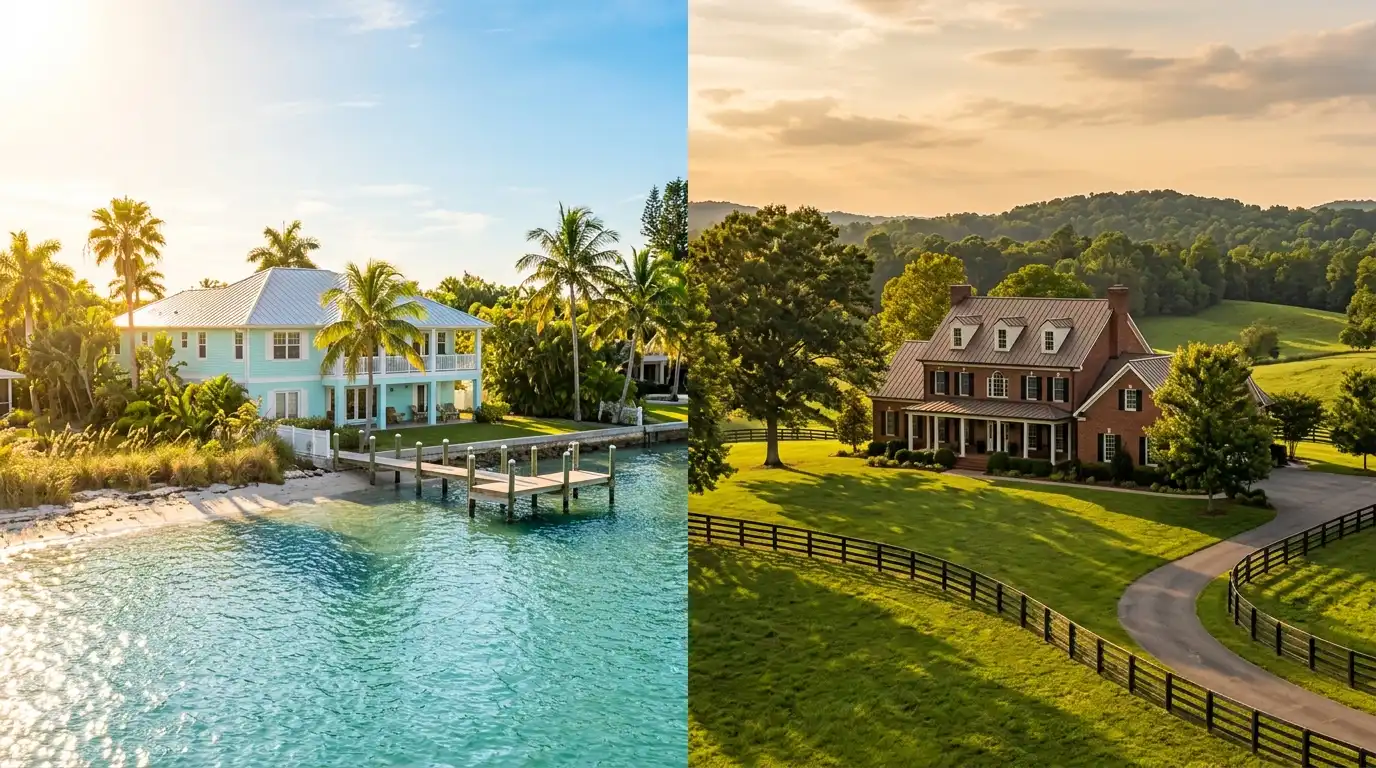
Nashville vs Tampa: The Honest 2026 Comparison (Insurance, Taxes, Schools & Real Estate)
Nashville and Tampa are two of the most-searched relocation comparisons in the country right now, and it is not hard to see why. Both are in the South. Both have no state income tax. Both have strong, growing economies. On the surface, Tampa looks like the cheaper option, and on the purchase price alone, it is. But when you run the full numbers, one of these cities carries a hidden cost that quietly reshapes the math. We work with Tampa buyers every week, so let us walk through it the way we would on a call: cost of ownership first, then schools, jobs, lifestyle, and finally the real estate and investment picture.
Nashville vs Tampa at a Glance: 2026
- State Income Tax: Both zero (Tennessee and Florida)
- Median Home Price: Tampa ~$393K-$433K; Nashville metro ~$470K; Franklin and Brentwood ~$800K-$1.2M
- Property Tax (on a $450K home): Tampa ~$4,000/yr; Nashville ~$2,500/yr
- Homeowners Insurance: Tampa/Florida ~$7,000-$10,000/yr; Nashville ~$2,000/yr
- Total Cost of Ownership: Same-priced home costs ~$800-$1,000/month more in Tampa
- Schools: Williamson County ranked #1 in the Nashville area, #4 in Tennessee
- Hurricane Risk: Tampa, coastal storm-surge exposure; Nashville, none
- Where Tampa Wins: Beaches, 233 sunny days a year, lower purchase price
Cost of Living: Home Prices, Nashville vs Tampa
Let us start where most buyers start, the sticker price. The median home price in Tampa runs roughly 393,000 to 433,000 dollars, so call it around 400,000. The Nashville metro median sits near 470,000 dollars. And in Franklin and Brentwood, which sit inside one of the most highly regarded public school systems in the state, you are realistically looking at 800,000 to 1.2 million dollars.
So on the purchase price alone, Tampa is going to look cheaper, because it is. Comparing Davidson County, Tennessee to Tampa, that is roughly a 40,000 dollar swing on a similar kind of house. If your whole decision came down to the number on the listing, this comparison would be short. But the listing price is only the down payment on the truth. Here is where the math completely changes.
Property Taxes: Nashville Wins Cleanly
Property taxes are the first place the gap opens up. On a 450,000 dollar home, a Tampa owner pays about 4,000 dollars a year in property taxes. The same-value home in the Nashville area runs closer to 2,500 dollars a year. Nashville beats Tampa on property taxes, and it is not particularly close. That is roughly 1,500 dollars a year back in your pocket before we even get to the number that changes everything.
The Insurance Number That Changes Everything
This is the single most important section in this entire comparison, and it is the one most relocation videos skip. Homeowners insurance in Tampa is the number that quietly reshapes the entire decision.
For context, the national average homeowners insurance premium is about 2,543 dollars a year. Nashville sits around 2,000 dollars a year, at or below the national average. Tampa, and Florida broadly, is a different universe. The statewide average has climbed to roughly 7,000 to 10,000 dollars per year. That is approximately 181 percent above the national average. A number of major insurance companies have simply pulled out of Florida entirely, which reduces competition and pushes prices higher still.
HOA Dues: The Quiet Multiplier
Insurance does not stop at your own policy. If you buy a condo or a home in an HOA community in Tampa, which most buyers there do, the HOA fees have climbed about 17 percent recently, the largest HOA increase of any metro in the country. The reason traces straight back to insurance: condo associations carry master insurance policies, and those master policies have roughly doubled since 2022. That cost trickles down to every individual owner.
In Tampa, the average condo runs around 655 dollars a month in HOA dues. For single-family homes in Tampa, you are typically looking at 100 to 250 dollars a month. In Nashville, HOA dues typically run around 100 to 150 dollars a month, with no hurricane-driven master-policy spikes behind them.
Total Cost of Ownership: The Honest Bottom Line
Now stack it all together. When you combine property taxes, homeowners insurance, and HOA dues, owning a home in Tampa will likely cost you 800 to 1,000 dollars more per month than buying the same-priced home here in Nashville. That is the part that surprises people. The Tampa home is cheaper to buy and meaningfully more expensive to own.
| Ownership Cost (apples-to-apples, similar home) | Nashville Area | Tampa, FL |
|---|---|---|
| Purchase price (metro median context) | Higher (~$470K metro) | Lower (~$400K) |
| Property tax (on a $450K home) | ~$2,500/yr | ~$4,000/yr |
| Homeowners insurance | ~$2,000/yr | ~$7,000-$10,000/yr |
| Typical HOA dues | ~$100-$150/mo | $100-$250/mo (home); ~$655/mo (condo) |
| Net monthly cost of ownership | Lower baseline | ~$800-$1,000 more per month |
Over a ten-year hold, that monthly gap compounds into roughly 100,000 dollars or more, money that has nothing to do with your home’s value and everything to do with where it sits on a map.
Want the Real Cost-of-Ownership Math for Your Situation?
Send us the Tampa home you are weighing and the Nashville budget you have in mind. We will line up the true monthly carrying cost side by side, honestly, before you make a move.
Get My Side-by-Side Cost BreakdownHurricane and Flood Risk: The Long-Term Asset Question
This is the section most comparison videos skip, and it is the one that matters most for long-term financial planning. Tampa sits at the end of Tampa Bay, which is essentially a long funnel of water, and storm surge is a genuine factor. Hurricanes Milton and Helene made that vivid for a lot of Florida homeowners.
A few things are worth understanding before you buy on the Florida coast. Flood insurance is separate from homeowners insurance, and in the areas hardest hit by recent storms, only about one in four homeowners actually carry a separate flood policy. The maximum payout on many of those policies is around 250,000 dollars, which does not come close to covering today’s rebuilding costs. Even homeowners who carry full coverage, a hurricane policy, and flood insurance still face delays, disputes, and denials. Some insurers have gone insolvent. The ones still operating are raising deductibles and limiting policies in high-risk zones.
The Nashville Counterweight
Middle Tennessee is inland. There is no hurricane season, no storm surge, and no evacuation planning. Nashville does see spring and fall severe weather and occasional tornadoes, and that is worth respecting, but it does not carry Florida’s coastal catastrophe exposure or the insurance crisis that comes with it. A home is a long-term asset. When you are planning for the next 10, 20, and 30 years, the climate and insurance trajectory belongs in the math.
Schools: Williamson County vs Hillsborough County
If you are relocating with children, this is a conversation we should have directly. The first thing to understand about Nashville is that Davidson County schools and Williamson County schools are two completely different animals. If schools are a priority, you will want to zone in on Williamson County, which covers Franklin, Brentwood, Nolensville, and Spring Hill.
Williamson County Schools carry an overall A grade on Niche, rank as the number one district in the Nashville area, and rank number four in the entire state of Tennessee. That is genuinely impressive depth across an entire county.
Hillsborough County, in the Tampa area, has strong individual magnet and IB programs. Schools like Tampa Bay Tech, Middleton, and Steinbrenner all earn A ratings and are very respectable. The honest distinction is consistency. If you buy in Williamson County, you are in one of the top districts in the entire Southeast almost regardless of which specific home you choose. In Hillsborough County, quality can vary from area to area, so research the exact school zone for any address before you pull the trigger.
Jobs: Nashville vs Tampa in 2026
Both cities have real economies, so the right question is which one fits your industry. Nashville has always been a healthcare capital of America, with more than 500 healthcare companies headquartered here. But the bigger 2026 story is concentrated and highly visible. Oracle chose Nashville for its new headquarters, bringing more than 8,000 high-paying jobs. Amazon is building a downtown operations hub with roughly 5,000 more. Nashville ranked number two in the country for job growth and income among major metros.
Tampa’s economy is genuinely strong too. The Tampa metro added about 15,000 private-sector jobs year over year, one of the bigger stories nationwide, anchored by a strong financial-services hub and a growing tech presence. The simplest way to read it: if you work in healthcare or tech, Nashville has the edge in 2026. If you work in financial services, Tampa stays very competitive and deserves a hard look. If you work remote and can choose either, let the cost of ownership and lifestyle decide.
Lifestyle, Weather, and Beaches
This is where Tampa earns its points, and we are not going to pretend otherwise. Tampa has about 233 sunny days a year, and January averages right around 60 degrees. If sunshine is your top priority, Tampa delivers. Nashville offers a different rhythm: four true seasons, with stunning spring and fall, summers that are warm but not Florida heat, and winters that bring occasional snow. There is no hurricane season here, which means no evacuation planning and no watching the weather channel all night.
On beaches, Tampa simply wins. Clearwater Beach and St. Pete Beach are among the best in the entire country, and nothing in Middle Tennessee competes with that. What Nashville offers instead is Old Hickory Lake, Percy Priest Lake, and the Cumberland River for boating, fishing, and paddleboarding, plus the Great Smoky Mountains about three hours away. It is a legitimate outdoor lifestyle, just a different one. If beach access is non-negotiable, that is an honest point for Tampa.
Real Estate and Investment Outlook
Now to our favorite topic. In the highly sought-after Williamson County corridor, well-priced homes in Franklin and Brentwood begin in the high 600s and quickly approach the 800,000 to 1.2 million mark. We are still seeing multiple offers on well-priced, attractive homes. Over the long term, Nashville-area prices have climbed steadily, supported by a strong economy and an excellent job market.
In Tampa, the same home is likely to cost you 40,000 to 80,000 dollars less up front. Inventory across many Florida markets has surged, up as much as 80 percent year over year in some areas, which gives buyers more leverage right now because more people are moving out than moving in. The wild card, again, is the insurance crisis. Buyers who used to look only at Florida, from Chicago, New York, and the Northeast, are increasingly looking hard at Nashville instead.
From an investment standpoint, Nashville rewards long-term buy-and-hold, particularly in Franklin or Brentwood inside Williamson County. Tampa offers a lower entry price and more negotiating leverage today, but you have to study what the long-term climate and insurance picture does to your carrying cost and resale before going all in.
Thinking About Trading Tampa for Tennessee?
We help Florida buyers map budget, schools, and commute to the right Williamson County community, and we tell you the truth about a price or a school boundary before you sign anything.
Talk Through Your Nashville MoveWhere Each City Wins: The Honest List
No spin. Here is how we would summarize it for a buyer on a call.
| Tampa Wins | Nashville Wins |
|---|---|
| Beach access (Clearwater, St. Pete) | Lower total cost of ownership (~$800-$1,000/mo) |
| 233 sunny days, mild winters | Top-ranked Williamson County schools |
| Lower purchase price (~$40K-$80K less) | Far lower homeowners insurance and property taxes |
| More buyer leverage and inventory right now | No hurricane season or storm-surge exposure |
| Strong financial-services job market | Healthcare and tech momentum (Oracle, Amazon) |
If sunshine and beaches sit at the very top of your list, Tampa makes a strong case. If long-term cost of ownership, school quality, and a stable insurance and climate picture matter most, the honest answer points to the Nashville area, and specifically Williamson County.
Frequently Asked Questions
On sticker price alone, Tampa is cheaper, with a median home around 393,000 to 433,000 dollars versus roughly 470,000 in the Nashville metro and 800,000 to 1.2 million in the Franklin and Brentwood school corridor. But total cost of ownership favors Nashville. Once you add Tampa’s property taxes, insurance, and HOA dues, the same-priced home can cost roughly 800 to 1,000 dollars more per month to own in Tampa.
Tampa sits on hurricane and storm-surge exposed coastline, and that risk is now priced in. The national average premium is around 2,543 dollars a year and Nashville sits near 2,000. Florida’s statewide average has climbed to roughly 7,000 to 10,000 dollars, about 181 percent above the national average. Several major insurers have left Florida, and condo and HOA master policies have roughly doubled since 2022.
For a similarly priced home, owning in Tampa can run roughly 800 to 1,000 dollars more per month, driven by higher property taxes, much higher homeowners insurance, and steeper HOA dues. On a 450,000 dollar home, Tampa property taxes run near 4,000 dollars a year versus about 2,500 in Nashville, and Tampa insurance can run several times Nashville’s.
Williamson County Schools carry an overall A grade, rank number one in the Nashville area, and rank number four in Tennessee. Hillsborough County has strong magnet and IB programs and several A-rated schools like Tampa Bay Tech, Middleton, and Steinbrenner. The difference is consistency: Williamson County quality is broad across the district, while Hillsborough quality varies more by zone, so verify the exact zoned school before buying.
No. Nashville and Middle Tennessee are inland with no hurricane season and no storm surge. Tampa sits at the end of Tampa Bay, where storm surge is a serious factor, as Hurricanes Milton and Helene showed. Florida flood insurance is separate, only about one in four homeowners in hard-hit areas carry it, and payouts often fall short of rebuilding costs. Nashville does see occasional tornadoes but not coastal catastrophe exposure.
It depends on your field. Nashville has 500-plus headquartered healthcare companies plus highly visible 2026 growth, including Oracle’s new headquarters (about 8,000 jobs) and an Amazon downtown hub (about 5,000 more), and ranked number two nationally for job growth and income. Tampa added roughly 15,000 private-sector jobs year over year with a strong financial-services hub. Healthcare and tech favor Nashville; financial services keeps Tampa competitive.
Florida inventory has surged, up as much as 80 percent year over year in some areas, giving buyers real leverage and lower prices than Nashville. The wild card is the insurance crisis and long-term climate risk. A home is a long-term asset, so weigh not just today’s price but what insurance, HOA, and carrying costs look like over 10, 20, and 30 years before committing.
The strongest options are in Williamson County, which pairs top-ranked schools with strong long-term value. Franklin and Brentwood are the flagships, with well-priced homes starting in the high 600s and approaching 800,000 to 1.2 million, still drawing multiple offers. Nolensville and Spring Hill offer newer construction at more accessible prices while still accessing Williamson County Schools. We can match your budget and school priorities to the right community before you fly in.
Have a Question We Did Not Cover?
Every Florida move is a little different. Tell us what is driving your decision, insurance, schools, taxes, or lifestyle, and we will give you a straight answer.
Ask Lorene DirectlyContinue Exploring Your Nashville Move
- Moving to Nashville, TN: The Complete Relocation Guide
- Living in Franklin, TN: The Complete Guide
- Westhaven, Franklin TN Neighborhood Guide
- Cool Springs, Franklin TN Neighborhood Guide
- Living in Brentwood, TN (coming soon)
- Franklin vs. Brentwood: Which Is Right for Your Family? (coming soon)
- Moving to Nashville from New York (coming soon)
Trading Florida Sunshine for Tennessee Stability?
We help Tampa and Florida families navigate the move to Franklin, Brentwood, and greater Nashville every week. We will tell you the truth about cost of ownership, school zoning, and the right neighborhood for your budget, before you ever get on a plane.
Talk to Lorene and Our Team
Social Cookies
Social Cookies are used to enable you to share pages and content you find interesting throughout the website through third-party social networking or other websites (including, potentially for advertising purposes related to social networking).